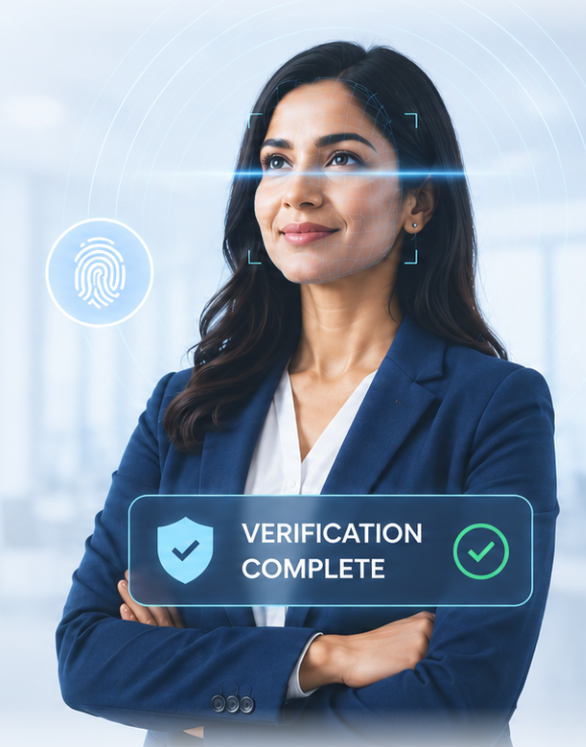
Voice Verification System and Face Match Verification for Secure Digital Identity
As digital services continue to expand, businesses need reliable ways to verify users without creating unnecessary friction. Traditional passwords, PINs, and security questions can be forgotten, stolen, or compromised. This has increased interest in biometric technologies such as a voice verification system and face match verification, which can help organizations establish whether a person is genuinely who they claim to be.
By combining voice and facial biometrics, businesses can build stronger identity verification processes for banking, financial services, healthcare, telecommunications, e-commerce, recruitment, and other digital applications.
What Is a Voice Verification System?
A voice verification system is a biometric technology that analyzes distinctive characteristics of a person's voice to help verify their identity. Instead of relying only on passwords or security codes, the system evaluates voice-related characteristics and compares them with a previously registered voice profile.
Modern voice verification solutions can assess factors such as vocal characteristics, speech patterns, and other biometric signals. Depending on the implementation, additional security mechanisms can also help identify suspicious or manipulated audio.
Voice verification can be particularly useful in situations where customers need to authenticate remotely. For example, a financial institution could use voice biometrics as one component of a multi-layer authentication process when customers access services through a call center or digital platform.
What Is Face Match Verification?
Face match verification is a biometric process that compares a person's facial image with another trusted image or identity document to determine whether they are likely to represent the same individual.
During an identity verification process, a user may provide a government-issued identity document and capture a selfie. Facial recognition technology can analyze facial characteristics from both sources and generate a similarity assessment.
Face match verification can help organizations reduce dependence on manual identity checks. It can also support digital onboarding by allowing customers to verify their identity remotely.
For higher-security applications, face matching may be combined with face liveness detection. Liveness technology helps determine whether the biometric sample comes from a live person rather than a photograph, screen replay, or other presentation attack.
How Voice and Facial Biometrics Work Together
Using multiple biometric signals can create a more comprehensive identity verification workflow. A typical process may involve several stages:
- User information collection: The individual provides the required identity information and supporting documents.
- Facial verification: A selfie or video is captured and compared with the facial image associated with the identity document.
- Liveness assessment: The system checks whether the facial sample appears to originate from a live individual.
- Voice verification: Where appropriate, the user provides a voice sample for biometric comparison.
- Risk assessment: The available signals can be evaluated together with other verification information.
- Verification decision: The organization determines whether the submitted information meets its predefined verification requirements.
This layered approach can provide additional security compared with relying on a single authentication factor.
Benefits of a Voice Verification System
A properly implemented voice verification system can provide several operational benefits.
Convenient Authentication
Voice-based authentication can reduce the need for users to remember additional passwords or security questions. This can make certain authentication experiences more convenient.
Remote Verification
Voice biometrics can be useful for remote interactions where customers communicate through voice-enabled channels. It can complement other digital identity technologies without requiring a physical visit.
Additional Security Layer
Voice verification can serve as an additional biometric factor alongside passwords, device information, facial verification, or other security controls.
Improved User Experience
When implemented appropriately, biometric authentication can reduce repetitive authentication steps while maintaining an identity-focused security process.
Benefits of Face Match Verification
Face matching is increasingly used during digital onboarding and identity verification because it can connect a person's live facial image with trusted identity information.
Faster Digital Onboarding
Automated facial comparison can help reduce manual review requirements and support faster customer onboarding.
Identity Document Comparison
Face match verification can compare a selfie with the portrait contained in an identity document, helping organizations establish whether the two facial images correspond.
Fraud Risk Reduction
Facial verification can be incorporated into broader fraud prevention workflows to identify inconsistencies between submitted identity information and biometric evidence.
Scalable Verification
Automated biometric workflows can support large numbers of verification requests without requiring every submission to undergo the same level of manual intervention.
Applications Across Different Industries
The combination of voice and facial biometrics has applications across multiple sectors.
Banking and financial services: Financial institutions can use biometric verification as part of customer authentication, account onboarding, and fraud prevention workflows.
Telecommunications: Telecom providers can incorporate facial and voice verification into customer authentication and account-related processes.
Healthcare: Secure identity verification can help healthcare platforms confirm users during remote interactions and digital service access.
E-commerce: Online businesses can use identity verification technologies for higher-risk transactions, account protection, and customer onboarding.
Recruitment: Employers and recruitment platforms can combine identity document checks with biometric verification to strengthen candidate verification processes.
Building a Stronger Digital Identity Verification Strategy
Biometric technology should not be viewed as a standalone solution. Effective identity verification generally requires a combination of technologies, risk controls, secure data handling, and appropriate verification policies.
Organizations considering a voice verification system or face match verification should evaluate factors such as accuracy, fraud resistance, integration capabilities, privacy requirements, scalability, and user experience.
It is also important to use biometric information responsibly and implement appropriate safeguards for the collection, processing, storage, and protection of sensitive identity data.
Conclusion
As digital interactions become increasingly important, businesses need authentication methods that balance security, convenience, and operational efficiency. A voice verification system can provide an additional biometric authentication layer, while face match verification can help connect a person's facial identity with trusted identity information.
When these technologies are integrated with liveness detection, document verification, risk assessment, and other security controls, organizations can develop a more comprehensive approach to digital identity verification. The result is a verification workflow designed to support secure digital experiences while reducing unnecessary friction for legitimate users.

About Premium Author
This post has been authored and published by one of our premium contributors, who are experts in their fields. They bring high-quality, well-researched content that adds significant value to our platform.